Thursday, 21 June 2012

Psycho (1960)


In trepidation of my first viewing on TV of Psycho, I hid in the kitchen for the key moment of the shower scene. Cowardy custard.

Audiences of 1960 were not so fortunate.


In all his six decades of filmmaking, and for what in most of that time has generally been considered his masterwork portfolio of cinematic craft, Alfred Hitchcock is best remembered for this shocker - one of his cheaper efforts - but how rightly so. Psycho is probably not nowadays the most terrifying film ever made - time and the outside world have hardened people's resolve so much - but it still has the most terrifying music score.

From the time of the credits to the time of the shower scene, that score by Bernard Herrmann is always brimming away in the background, making you aware, particularly during the long car journey, that something is going to happen at the end of this...

It must have been bizarre to be asked to come and see a film which could only be watched from the beginning or not at all - this in the days when roving film shows allowed paying audiences to enter the cinema whenever they liked, hence the expression "this is where we came in". Added to that, there is the added tease of a plot involving stolen money from a Texas office, rashly entrusted into the hands of feisty Marion Crane (Janet Leigh), who could use that $40,000 very nicely thank you, for her potential nuptials with illicit boyfriend Sam Loomis (John Gavin).


Guilt-ridden along the long drive out of Arizona however, an almost judgmental shower (ah, the metaphor is appropriate) falls down and she takes refuge at an out-of-the-way hostel called The Bates Motel. After a little friendly talk with the young and slightly repressed owner's son Norman, Marion decides to take back the $40,000, and then have a shower...

For whatever reason - perhaps because it was deemed too shocking even for Hitchcock - the responsibility for directing the shower scene has sometimes been credited to Saul Bass. It brings into question who actually is the maker of a film? Bass's storyboards (together with his nifty title sequences that were his stock-in-trade) were used by Hitch as the blueprint for all the murder scenes, and Hitch, grateful for Bass's visual input, invited Bass onto the set (right) and gave him the generous credit "Pictorial Consultant" that started the whole controversy over 'directing' the shower scene.

As great as the shock of a vicious murder taking place before our very (perceived) eyes, is the still unparallelled shock in movie history of a story losing its central character, as well as the sub-plot that goes with her too (although the credits drop the hint with the "and Janet Leigh" at the beginning).

From that moment on, you feel anything could happen. Once the situation is set up, and the rules of storytelling defiantly broken, the Master draws you in.

A particular fine example of his craft is the long staircase tracking shot, following the mysterious Norman as he chats with Mother and drags her down to the basement, Hitch teasing the audience but knowing that they, like he, don't want to get too close to this strange family. It is the quintessential suspense of the slightly open door.


Far more shocking for me, on reflection, than the stabbing of Marion is the horrific death of the intrepid investigator Arbogast (Martin Balsam), thus breaking another rule of story telling: you don't kill off your detective before he's finished detecting! Balsam is the figure of integrity,  the one who's going to sort things out for us. It was also a death that, unlike Marion's, I wasn't expecting. Once he's gone, you don't really envy anyone who tries to go into that house.

How could Hitch have known what it would lead to? A whole spate of slasher shockers in the decades to come, including three deteriorating sequels, and most curious of all, a 1999 Gus Van Sant remake using exactly the same script, a curious case of cinematic plagiarism (or as Van Sant put, his "cover version" of a classic), whose lack of success proved that you cannot make a film any better than that already made by a master filmmaker.

One figure at the end, however, leaves audiences in no doubt that this is far from a laughing matter: that final creepy shot of Anthony Perkins is still difficult to watch without severe trepidation - even more than the shower scene - when that last sinister face reveals itself at the end of the film.


I experienced (there's no better word for it) Psycho in the cinema for the first time at long last, at the Prince Charles Cinema on a Halloween horror themed weekend (time had sanitized the horror down from X certificate to 15), of which the greatest impression felt was the sound: significantly higher on the soundtrack than usual, with Herrmann's score screeching out. Come the time of the shower scene, I was less afraid of being scared than of being deafened. At least then I was able to get some idea of what original audiences of the time went through.

Saturday, 2 June 2012

Spiderman (2002)

This one's a late addition to the list, but I have to include it for all sorts of sentimental reasons. The first reason, among others, is because it was one of the last genuinely enjoyable comic book films that I saw at the old Odeon Colchester, incorporating the best elements of both Superman and Batman (whose composer Danny Elfman provides an evocative score), and its nostalgia for New York is poignant (more of this later.) It also has one of the sexiest screen kisses in cinema history.

At the turn of the 21st century, there had been much mooted plans (as there usually are with most comic strip films nowadays) to make a new film version of the popular Spider-Man series. Up until then the character had been half-heartedly adapted for American television (and perhaps more entertainingly in a cartoon series with a catchy theme in the 1960's), but with the release in the 1970's of Superman followed a decade later by Batman, it was probably only a matter of time before Marvel's counterpart to these two icons spun his way onto the big screen proper.

When the time did come, the choice of director was unusual, but ultimately ideal. Sam Raimi had groomed his cinematic career on low-budget, high-octane zombie horror such as the Evil Dead series, followed by the violent comic book avenger Darkman (starring Liam Neeson), which, as well as dipping into the mainstream also opened the eyes of Columbia studio executives who were considering possible directors for their new Spider-Man epic.

Raimi's own enthusiasm for the original comic books helped a great deal, and his cast were near-perfect: Tobey Maguire, already an established name from acclaimed films such as Wonder Boys and The Cider House Rules, pipped contenders such as Jake Gyllenhaal for the coveted title role, and brought as fine a definition of Peter Parker as Mark Hamill brought to Luke Skywalker and Cheristopher Reeve brought to Superman. Kirsten Dunset was another "young veteran" (playing a centuries old vampire opposite Tom Cruise at the age of 12), with the perfect girl next door persona to play Mary-Jane Watson. Added to them on the other side of the coin were Willem Dafoe as egomaniac villain Norman Osborne (aka. The Green Goblin), and James Franco as his son Harry, one of the best of the new generation of young actors. If Dafoe overplays a little (though not quite in the Jack Nicholson mode), both he and Dunst are ultimately constricted by their roles.

The rest of the cast were also exemplary, borrowing heavily from Superman in style with J.K. Simmons' hack newspaper editor echoing Perry White, and Rosemary Harris and Cliff Robertson playing Peter's aunt and uncle with all the integrity of Ma and Pa Kent. To add the fun, Raimi brought in his Evil Dead star Bruce Campbell to play a bit part (who announces the title character's name for the first time.) Even co-creator of the comics himself, Stan Lee, makes an appearance (his first of many in the Marvel series).

The other major co-star of Spiderman however, and the touchstone of the film's lasting appeal, is its sentimental and heart-rendering depiction of New York: less of a modernistic, materialistic metropolis here, more of a kinder, community-based city that grew out of these hopes and desires. The timing of the film's release was fateful indeed: in the course of post-production during 2001, the twin towers of the World Trade Centre (between which one major sequence was filmed), were engulfed in the awful terrorist bombing of 9/11 - an expression which I frankly loathe as an abrupt text message style name, written by and for the low attention span modern era.

The impact of the atrocity nonetheless, and the spirit of the city that emerged through it, are imbued throughout Spiderman, such as the moving scene where firemen (who so valiantly laid down their lives for others on September 11th) try to rescue a child from an apartment block where Spidey helps out. Raimi and his collaborators developed this theme further in SPIDER-MAN 2, where a speeding subway train propelled by the evil Dr. Octopus (an excellent Alfred Molina) is stopped in its tracks by the wounded young hero, for whom the New Yorkers inside the train gratefully carry him above them Christ-like having just survived the ordeal. Spider-Man 2 was an accomplished and in some ways improved sequel, that developed the ideas of the first film and also complimented them in a similar vein to The Empire Strikes Back.

Less so for Spider-Man 3 however, a nonetheless honourable effort, but for whom the studio insisted that Raimi include a third, unnecessary villain (in addition to the Sandman and the now ascendant Green Goblin Harry Osborne) in the shape of Venom, the most popular villain from the comics. For this reason as much as any other, inexplicably within a very short space of time Columbia chose to "reboot" Spiderman all over again, with a new director, new stars, and presumably newer, "better" CGI - when in truth the story had been pretty well covered the first time.


Time I think, will be kinder to Spider-Man however. Other revisionist comic book films have since been made trying to incorporate modern war-on-terror anxieties, but posterity will remember Sam Raimi's heartening rendition for putting all (or most) of the right ingredients together, and for providing an invaluable record of the zeitgeist of - yes, I'll say it - 9/11.


Monday, 23 April 2012

The Adventures of Robin Hood (1938)

It sometimes shocks me to discover that there are those erstwhile filmgoers who do not know of Errol Flynn. I daresay in the generations to come, film audiences will similarly be saying "Harrison who?", or wonder how on Earth anybody could possibly become a movie star with names like Leonardo DiCaprio or Arnold Schwarzenegger.

Well, Errol Flynn was every bit as great as these and more. From Tasmanian upbringing (legend has it that he stowed away) to brief work in early British sound films, his rogue beauty buccaneered its way into Hollywood in some obscure roles before Warner Brothers took the bold move of casting him as Captain Blood (in place of original choice Fredric March) alongside 18-year old Olivia De Havilland (right), in an exciting, rousing swashbuckler directed by Michael Curtiz with a notable duel with suave Basil Rathbone as a slimy rival pirate: the legend of Errol Flynn was born.

I myself first heard of him only by association, from a college lecturer who was travelling with me to Nottingham to visit relatives, and we spoke of the area of Sherwood, and he invoked the named of Errol Flynn. The name was passed on wisely.

Flynn's portrayal is still the definitive Sir Robin of Locksley, surpassing all the other notable Robins such as Richard Greene, Richard Todd, Sean Connery, Michael Praed, Jason Connery, Kevin Costner, and now Russell Crowe. Even Flynn's great predecessor Douglas Fairbanks, the greatest of all silent stars, whose Robin Hood in 1922 was considered unsurpassable, doesn't quite come up to Flynn's matchless charm.

Perhaps the timing of the film was its crucial asset. In the 1930s, Warner Brothers had already come to grips with the sinister rise of fascism across the Atlantic in Europe. The notably titled Confessions of a Nazi Spy (1939) dared to speak out against a regime that America was not yet at war with. As for The Adventures of Robin Hood, the timing was apposite, and Warners made sure that Errol Flynn's Robin embodied all the heroism of a just cause. Somehow this evergreen depiction of Sherwood all makes sense: the myth, the heroism, the history. And it also had timely statements to make about the struggle against the Nazis.

Significantly to point up the threat, Warners made Robin's opponents a veritable tripartite of deceitful villainy: the scheming, vindictive Prince John (Claude Rains), the corruptible Bishop of the Black Canons (Montagu Love), and never to be outdone by those two, the one and only Basil Rathbone, as Sir Guy of Gisbourne - NOT The Sheriff of Nottingham as sometimes mistaken (who was played endearingly by Melville Cooper, and later portrayed in rumbustious fashion by Alan Rickman in 1991.) The formidable opposition meet their match however in a superb cast of Merrie Men: Alan Hale as a marvellously confident Little John (his second of three portrayals spanning 28 years), the seasoned veteran Eugene Pallette as the lugubrious, passionate Friar Tuck, and ultimately their trump card: their crusading king, Richard the Lionheart (Ian Hunter).

Having been lured into Sherwood Forest with their illustrious booty to pay for the taxes plundered by the merry men, the terrible trio soon have retribution in mind with a sinister plan to lure Robin into a trap, by staging a stirring archery tournament, scored in gloriously operatic fashion by Erich Wolfgang Korngold. John Williams and Star Wars owes a great debt to Korngold for the exciting, multi-setting finale encompassing all the different characters' exploits.


William Keighley's beautifully evocative Sherwood Forest (shot in beautiful leafy Pasadena) scenes were deemed to be slowing up the action, and so Warners called upon another trusted master of the action spectacular, Michael Curtiz (who later went on to direct Casablanca) to crank up the action, as the villains take an iron grip on proceedings and imprison Marian, and then treacherously threaten to murder the returning King Richard. It all leads to a stirring finale (another influence for Star Wars and other adventure epics), and one of the best screen duels ever, between Robin and Gisbourne.

Of all the Robin Hoods ever told - and there have been countless versions on stage, screen, television, and even by minstrel - Flynn was the quintessence of the rebellious hero, and Robin Hood was his greatest showcase, and with good reason.
 

Thursday, 4 August 2011

Bambi (1942)

The day I first saw Jurassic Park at the Empire Leicester Square, my little sister also saw Bambi for the first time at the Odeon Colchester. It was, likewise for her, a pivotal cinematic experience. For successive generations of children (before the age of DVD), there was a whole cycle of classics (as they truly deserve to be called) which the Disney studio had the canny sense to release every decade or so for every succeeding generation of young children, who knew a timeless classic when they saw one.

If you want the rites of passage story, quintessentially this is it, translated in anthropomorphic terms, playing on children's sentimental fondness for animals, within some beautifully natural settings. The Disney studio could not surpass this film for standards in animation (Fantasia and others have only matched it) from what was unquestionably their Golden Era. The opening, atmospheric, multi-plane animated tracking shot through the forest (accompanied buy some great music throughout the film) sets its stall out quite magically from the first.

To heighten the atmosphere, Disney and his animators worked very hard to draw authentic deer (bringing live ones into the artists' studio to study their movements), away from their hitherto cartoony approach to most of their main characters. The potentially heavy subject matter combined with the obsession for naturalism was offset however by the light relief engendered through the other animal characters in the woods - less naturalistic than the deer, and therefore open for much more comedic possibilities. "Flower" the skunk is quite an endearing character, so too the Wise Owl, but the most memorable comic creation in Bambi is Thumper the rabbit, who has most of the best gags and the most peerless of wisdom, including a maxim (taught by his father rabbit) that many a critic would do well to heed:

"If ya can't say somethin' nice, don't say nothin' at all."


The saddest, most powerful scene in children's cinema is where Bambi looks back through the snowy meadow, and wonders where his mother has disappeared to. Scores of children through the decades have sat in the cinema (or nowadays, in the living room), with perplexed confusion and uncertainty, sometimes giving way to tearfulness, asking their parents what's happened

For my part, when I first saw Bambi at the Odeon Aylesbury in 1978, like most children I wasn't without my own share of tears (and in some ways, still am), but in later years I can look back with an equal amount of poignancy at the quiet, commanding but moving presence of the father figure, particularly at the end when the now fully grown Bambi takes his place, and the former Great Prince of the Forest quietly departs.

Sunday, 17 July 2011

Jurassic Park (1993)

Saturday, 17th July 1993: the day is etched in my memory as being quite a memorable one. Thanks to my friend Craig Stevens' skills in getting an opening weekend ticket, I watched the first big screen release in the UK of Steven Spielberg's latest blockbuster - the day when cinema special effects moved up to the next level.

Never mind that cinema was changing from that day onward; it was just a bloody good film, one that reaffirmed Spielberg's ailing career after his previous efforts - in particular his previous film Hook had packed in his loyal audience, but few of them or the critics were moved. The sight of a giant inanimate crocodile devouring Captain Hook was supplanted a year later by the far greater cinematic image of a terrifying velociraptor attack, and the mighty T-Rex telling everybody who's boss on Isla Nublar.

The genesis of this cinema landmark came from the playfully imaginative mind of the late Michael Crichton, who made a buck or two out of his own scientific thrillers, as much as Dan Brown made a mint out of exploiting archaeology and religion, and Ian Fleming from the intelligence service. A little knowledge, it seems, goes a long way.

The template for Jurassic Park was Crichton's own 1973 cult sci-fi thriller Westworld: a seemingly idyllic theme park where guests can live their dreams and be characters in the Middle Ages, Ancient Rome, or the Wild West, without any fear of damage to their person - until of course, the science begins to show its imperfections and things start to go wrong. The thrilling sight of Yul Brynner's robotic gunfighter relentlessly pursuing hapless Richard Benjamin through the various worlds was scary, quirky, and of course highly far-fetched, but Crichton was having fun staging the ultimate Wild West chase, with a 1970's spin.

The climactic third act of Jurassic Park very much mimics that of Westworld, where supporting characters (among them a pre-stardom Samuel L. Jackson) intrinsic to the running of the theme park curiously disappear or get killed off, leaving the heroes - and the antagonists - to fend for themselves. Among the latter is Dennis Nedry (Wayne Knight), a rare case of stereotyping by Spielberg, portraying the film's chief catalyst as a fat, fast-food eating slob of a computer wizard, whose hi-tech skills lead him to greedily steal the precious DNA samples, and who in the process shuts down the fences during a particularly badly timed storm, which unleashes the dinosaurs - whom inevitably, claim Nedry as their first victim.

Those among the heroes left behind therefore to deal with the mayhem are Dr. Ellie Sadler (the always excellent Laura Dern) and her business/life partner Dr. Alan Grant, played in droll fashion by Sam Neill, the cinematic man for all seasons whether in British or Antipodean comedy or drama, or the supernatural (such as the adult Damien in The Final Conflict) and science fiction, not just for Spielberg but also subsequent cult items such as the TV series Space and cult Australian comedy The Dish.

Also most notably making a return to acting after 16 years behind the camera was Richard Attenborough as billionaire John Hammond, the book's original Frankenstein figure, but here translated by Spielberg and Crichton into a much more jovial and only marginally Machiavellian owner of the theme park (clearly modelled on Walt Disney), who is as much a victim of the science as anyone else. Hammond's mentality in Spielberg's version is essentially that of the showman or movie producer who wants to produce a great spectacle (and Attenborough himself has certainly made his own fair share of spectaculars such as Gandhi), and leaving scientific morality to the philosophers (and the scientists). In a sense, Hammond also mirrors elements of Steven Spielberg.

The scientific Devil's Advocate therefore, shows up in the presence of the wisecracking "chaotitian" Dr. Ian Malcolm, a great cameo for Jeff Goldblum. Just as Star Wars had its cynical Han Solo-type figure, so does Jurassic Park have its cynical protagonist in the shape of Golblum's character who voices the film's scientific conscience ("You're scientists were so preoccupied with whether they could they didn't stop to think if they should!") - although as most science boffins will tell you, a lot of the science of Jurassic Park is highly theoretical - the sight of the T-Rex on the Jurassic logo is Cretaceous Era rather than the Jurassic Era. But what did it matter, the very idea - no matter how improbable - that dinosaurs and Man could share the Earth in the modern world, is still chilling and thrilling. The film, and the book, are very much the most gloriously conceived science faction.


Dr. Ian Malcolm (Jeff Goldblum) flirts with Dr. Elly Sadler (Laura Dern). The flirtations were off-camera as well as on.


The discreetly hidden name - one might say the ghost editor - behind Spielberg's huge success was that of George Lucas. It was he who supervised the editing - and of course, the special effects - of Jurassic Park whilst Spielberg was away in Poland shooting Schindler's List - considered by many to be his masterpiece.

I have failed to mention in the course of this blog, Spielberg's familiar well-established working relationship with child actors. In this respect he was also well served by two exemplary members of that breed, Ariana Richards and Joseph Mazzello (outstanding in Shadowlands and also Kubrick's original choice for the boy android in A.I.), who become the gullible victims of the dinosaurs. By the end there's no question of who's in charge of Jurassic Park once the T-Rex bursts his (or rather, her) way through the complex, as the slogan "When Dinosaurs Ruled the Earth" is knocked off its perch. Spielberg was so impressed by Industrial Light & Magic's work that he installed an eleventh hour ending for the T-Rex to give him his true star power. It was a pivotal moment, both in the story and in the field of cinema special effects.

The velociraptors prove too hot to handle, and are soon stalking young Timmy (Joseph Mazzello) in the kitchen: Spielberg's homage to Stanley Kubrick's The Shining.

Okay, plotwise the original story takes a hike once the dinosaurs take over, but this was always Michael Crichton's point anyway. Spielberg returned to the original novel in The Lost World: Jurassic Park (the one and only time he has filmed a sequel in name) which covered some of the darker elements that he didn't dare cover first time around, and a second sequel (with Sam Neill again) returned to the slightly more tongue-in-cheek aspects of the first film.

Looking back to that pleasant July day in'93, coming out of the cinema into Leicester Square was something akin to stepping off a fairground ride. There were those among us who were disappointed at the plot's shortcomings compared to the chilling original, but as a cinematic entertainment it could not be faulted and marked the beginning of a new era.

Wednesday, 29 June 2011

Twelve Angry Men (1957)

It's a cynical truism in the eyes of many that a suspect is Guilty until proven Innocent (as a character says in Star Wars spoof Troops, "all suspects are guilty, if they weren't guilty they wouldn't be suspects!") - certainly in a jury like this one. In all the times I've listened to or read about court cases, it perplexes me how seemingly obvious guilty (or innocent) suspects can be forensically scrutinized and pared down to the bone so that the slightest bit of evidence can be disproved. This I realise, is too often the syndrome of personal prejudice.

Step into this corrupt world the man in the white suit: Henry Fonda, as the anonymous (as they all are) Juror No. 8, imbued with all of Fonda's integrity and just a hint of suppressed insecurity; a pet project of Fonda's, it was he who successfully lured Sidney Lumet into faithfully transferring Reginald Rose's gripping TV play onto the big screen, for which international cinema can be eternally grateful.

There can be fewer better first films than this one, exemplifying the theory that when unleashed on a new medium for the first time the artist is at his greatest: I confess I find much of Lumet's work (with one or two exceptions) painfully laboured and dull, but here his camera angles and build up of tension make it his most cinematic film of the lot, and all practically within the setting of one room.

That the subject itself was also riveting and unusual probably helped: in 90 per cent of films with court cases the jury is the bunch of people who retire (and in some of the more cliched trials don't even have to do that) to consider their verdict. The twist here is that this is the first scene of the film and not the last. We are briefly afforded a glimpse of the defendant himself, which is perhaps a dangerous move as his nervous little face clearly informs how the drama will develop - whereas without him we the audience can become just as prejudicial as those in the jury room.

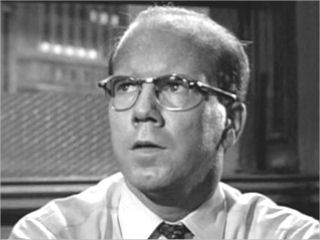
Not just Lumet, but his brilliant ensemble cast (who were so well rehearsed in their roles to have done the play on tour had they wished) all deserve their mention, not just Henry Fonda. Starting with the Foreman himself (Martin Balsam), an inwardly proud but humbled, self-effacing man, like so many of Balsam's later characters, who performs his tricky role as coordinator of the 12 as meekly or as unobtrusively as he thinks he ought to, and never tries to make his personal opinions or prejudices known, either one way or the other. Balsam quickly became a Lumet favourite.

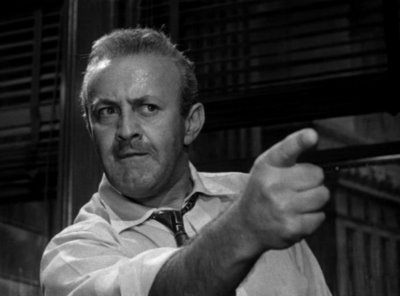
The Foreman however is upstanding and strong-willed in coparison to Juror No. 2, a funny little man as played with expert diligence by John Fiedler, but much smarter than he looks or sounds, often spoken down to by the bigger brutes in the jury who think they Know Better, of whom the most ballistic of the lot is Juror No. 3 (the explosive Lee J. Cobb), a man of deeply troubled convictions who can't help but compare the accused in the dock with his own troublesome son, and thereby becomes the hardest of the twelve nuts to crack. Next to him comes the second hardest, Juror No. 4 (E.G. Marshall) who is in some ways, the flip side of Fonda: an intelligent, educated man, but also very clinical, and for whom the supposed facts of the case easily match the crime.

Juror No. 5 (Jack Klugman) is on the surface, the vulnerable weakling of the jury, quickly betraying his slum origins similar to those of the defendant. It is to the credit of Klugman's skill and versatility that he can play such a nervous outcast as expertly as his later TV work (such as Quincy and The Odd Couple).

Edward Binns is Juror No. 6, another brilliantly versatile character actor, playing to his minor misfortune the least dramatically interesting of the twelve jurors: a principled working man - but only as far as it goes ("I don't suppose, my boss does the supposing..."), perhaps the typical average juror.

The most enjoyable of the twelve is the goofy but still prejudiced Juror No. 7, whose only passion is getting to the ball game on time - the first of many splendid star character roles for Jack Warden.

Next to Fonda is the wonderful Joseph Sweeney as Juror No. 9, the elder statesman of the group who naturally shrivels into the crowd at first (sympathising with one fellow elderly gent in the witness stand), but as the discussion in the jury room grows, so too does his confidence, and it is he who uncovers the key piece of evidence that swings the jury's verdict...

...unlike Juror No. 10 (played with commendable belligerence by Ed Begley), a racist bigot who huffs and puffs (and coughs) his way through his one-sided point of view, ultimately into self submission.

He is also irritated by the obsequious politeness of Juror No. 11 (Russian character actor George Voskovec), who has the perfect riposte to No. 10: it's the way he was brought up. A token immigrant New York presence in the twelve perhaps, but once again, brilliantly and thoughtfully played and sympathetically written. Finally there comes the slick operator Juror No. 12, whose vacuous world of advertising is as far removed from the defendant's as can be possibly imagined ("We were lucky to get a murder trial. I figured us for an assault or burglary, boy those can be the dullest. Hey, is that the Woolworth building?") and played to perfection by another future TV face, Robert Webber.

From all this it is apparent how the verdict will turn out, but it makes the process of watching it unfold all the more riveting. It is rare to find a film where all of the actors give excellent, well-thought out characterisation in almost every level of the drama, not only in the jury room but also in the judge's summing up at the end of the trial...and the finale where all the jurors descend the steps of New York's County Courthouse (below), taking all their prejudices - good or bad - out with them, but not without effect: the last of the jurors to descend the steps is the soberly thoughtful Juror No. 3.


Thursday, 7 April 2011

Cabaret (1972)

On the surface, the title suggests simple pleasures and delicious vice in fishnet tights and glamorous (or otherwise) performers in a hot, steamy setting. In the 1970's this was very much the image that was cultivated in publicity - that, and Liza Minnelli in a bowler hat.

But dig deeper. There is a reason why this "divine decadence" is so compelling. I track back to 1989: the fall of the Berlin Wall. The history of that city had long held a fascination for me, and it was shortly afterwards that I started reading William Shirer's The Rise and Fall of the Third Reich, so the whole atmosphere of that period in Berlin had long intrigued me. The tyranny of the Nazi era was infamous and inhumane, but what preceded it is a poignant and compelling illustration of the decadent calm before the storm.

I first became connected with Cabaret (based on Christopher Isherwood's atmospheric semi-memoir I am a Camera) in 1993, when the East Anglian Daily Times featured an article advertising a new theatre group in Walton-on-Naze asking for actors and performers. I had only a vague awareness of Bob Fosse's classic film version, but the reminder that it was set in 1930's Berlin set ears a-twinkling with interest - it's not just about Liza Minnelli, I realise, it's also about the rise of the Nazis.

Weimar Germany was a prime example of what happens when the people get too much of a good thing. Almost by accident or by default, the old ways of the Kaiser were set aside in the course of Germany's severest economic depression, and out of it came an outpouring of artistic frankness - a similar sense to the expression of free love in the 1960s - which is one reason why this subject appealed to the America of that decade, and still has resonances today.

It led however, in almost tragic operatic fashion, to the sweeping rise of Nazism which trounced it - the perfect subject for a Berthold Brecht/Kurt Weill-style opera on the subject. John Kander and Fred Ebb tapped into this rich field, and fashioned the first version of the musical as a grand vehicle not only for the seediness of 1930's Berlin, but also as a partial vehicle for Kurt Weil's widow Lotte Lenya as Fraulein Schneider (as also played by Jean Murphie in 1994, right), the tragic elderly landlady of Christopher Isherwood, in a fictionalised romance with a Jewish greengrocer, Herr Schultz.

To get onto the Broadway stage, it had to overcome many obstacles, not the least of which was the Jewish sensibilities towards the many anti-Semitic overtones, including the sight of a gorilla - Jewish by implication - dancing romantically with the Kit Kat Club's Master of Ceremonies (the unforgettable Joel Grey), and many other satirical moments, which were a true picture of Berlin society and the cabarets and nightspots (many of them Jewish owned) that painted the picture of the attitudes and social mores of the time.

In the local production, I played Ernst Ludwig, the charismatic smuggler of illicit goods into Germany from abroad - who it later turns out, is using these ill-gotten gains to fund the Nazi cause. I based the character on Ernst "Putzi" Hanfstaengl, a confidant of Hitler in the early 30's but also a reveller in the sleazy nightlife of Berlin which Hitler was later to exterminate. It was my first realisation that the evil of Nazism had a face. Any demonisation of them would distort the historical context and render them one-dimensional fantasy figures.

(That same year saw the release of Schindler's List in British cinemas, which saw another vicious Nazi, Amon Goeth (Ralph Fiennes) portrayed in a semi-sympathetic light in order to try and get into the head of the man, or perhaps more importantly for Steven Spielberg, to understand the reason for such evil.)

The production was a great fun, provocative, entertaining and thoughtful experience, in the process of which I had resisted the urge to watch the 1972 film until afterwards in the spring of 1994.

The film digests some of the operatic theatricality of the musical; it transposes and, where necessary, edits and amends it, back into the real world, bringing Isherwood's Berlin to life. Whilst some of these phases are sluggish, the general atmosphere of underlining decadent sleaziness, mostly in the setting of the Kit-Kat Klub, where most of the original songs from the musical are retained, makes for a brilliant juxtaposition with the growing political and sociological upheval.

And then, to play the starring role, Kander & Ebb found the ideal choice that they'd had in mind from the first: Liza Minnelli, who embodies not only the unflappable spirit of Sally Bowles (American style) but also brings on board the spirit of her mother Judy Garland - particularly in the moving solo "Maybe This Time", one of many extra songs written for the film.

In truth, the stage version captures the political implications much better than the film, but one unforgettable scene (transposed from the stage) still remains: at a seemingly innocent, idyllic outdoor beerkeller, the merriment is interrupted (and embellished) by the sound of an Aryan boy singing a beautiful solo, "Tomorrow Belongs to Me" - which in seconds becomes a rousing Nazi anthem, supported by nearly all of the crowd in one giant statement of ominous national fervour. Fosse brilliantly intercuts this with the image of one older gentleman, sitting unmoved at his table whilst all the others are singing - and the MC cuts in just at the end, with a sly, silent grin on his face.

Visually, Fosse's vibrant direction and Minnelli and Grey's performing dominate, but Michael York is also an excellent version of Christopher Isherwood, "Brian Roberts" (although Isherwood himself was mildly offended at the notion of his character being bisexual, when it seems he rarely had any physical attraction towards Sally Bowles.)

Most aficionados of Cabaret will come to it out of their appreciation of Liza Minnelli and then learn about the political context. I came to it from the opposite angle: Liza Minnelli was the finishing touch.

A landmark stage musical became an even more notable film. Both are classics of their medium.

100 Favourite Films

100 Favourite Films